
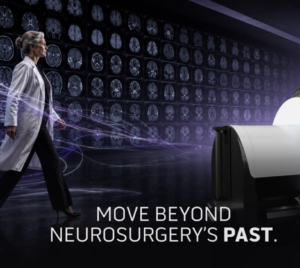
CyberKnife Moves Beyond Neurosurgery: There are over 200 thousand brain tumor cases a year, but today only 15% are treated by neurosurgeons. The vast majority are treated non-invasively by radiation oncologists using stereotactic body radiation therapy (SBRT) like CyberKnife.
CyberKnife Changing the World of Neurosurgery
The CyberKnife Robotic Radiosurgery System is fundamentally redefining the landscape of modern neurosurgery by turning what used to be highly invasive, high-risk brain and spine operations into painless, outpatient, “scalpel-free” procedures.
Originally invented by neurosurgeons at Stanford University Medicine, this breakthrough technology utilizes advanced computer science, medical physics, and a highly maneuverable robotic arm to deliver high-dose radiation with sub-millimeter precision (<1mm targeting error) from hundreds of unique angles.
Unlike traditional open neurosurgery or older stereotactic radiation platforms, CyberKnife eliminates the need for surgical incisions, anesthesia, or rigid metal head frames bolted into the patient’s skull. Instead, patients wear a comfortable, flexible mesh mask.
Key Capabilities Transforming Neurosurgery
| Feature | Traditional Neurosurgery / Early Radiation | CyberKnife Robotic Radiosurgery |
| Invasiveness | Scalpels, craniotomies (opening the skull), bone drilling. | 100% Non-invasive. Zero cuts, zero blood, no anesthesia. |
| Fixation Method | Rigid stereotactic metal frames screwed into the skull. | Frameless, using lightweight custom thermoplastic masks. |
| Motion Tracking | Relies on the patient staying completely frozen; treatment pauses if movement occurs. | Real-time AI tracking (Synchrony®) that dynamically shifts the beam with the patient’s breathing or shifting. |
| Treatment Timeline | Weeks of hospitalization and recovery, or 30–40 sessions of conventional radiation. | 1 to 5 brief sessions completed in 1–2 weeks; sessions can take as little as 15 minutes. |
| Recovery | Months of rehabilitation, wound care, and risk of surgical infections. | Immediate. Patients walk out and resume normal daily activities the same day. |
Expanding Neuro-Oncology & Functional Neurosurgery
The precision of the platform allows neurosurgeons to safely treat lesions that were previously deemed “inoperable” due to their deep locations near critical structures like the brainstem or optic nerve.
- Malignant & Benign Tumors: It achieves exceptional local control rates (>85% to 96%) for challenging conditions like brain metastases, acoustic neuromas, glioblastomas, and meningiomas.
- Vascular Malformations: It targets deep-seated Arteriovenous Malformations (AVMs), slowly obliterating dangerous abnormal blood vessels without the risk of an open surgical bleed.
- Functional Brain Disorders: CyberKnife is increasingly used to treat severe neurological conditions. For example, it is highly successful in calming the excruciating facial nerve pain of Trigeminal Neuralgia and reducing debilitating tremors in Parkinson’s disease by delivering precise functional blockades.
- Re-Irradiation Capabilities: Because the dose falls off sharply outside the target area, it can safely treat tumors that have already received prior rounds of radiation—offering a crucial lifeline for recurrent cancers.
Brain Tumor Treatment in Miami, FL
Treat Brain Tumors With Non-Invasive CyberKnife
CyberKnife treats all types of brain tumors very effectively. Nationwide, thousands of patients suffering from brain tumors have been treated using CyberKnife therapy while maintaining quality of life.
Thanks to breakthrough advances in technology, the CyberKnife uses radiation to ablate brain tumors and stop them from growing.
The pinpoint accuracy of CyberKnife also minimizes damage to surrounding healthy tissue, which can be a problem with standard radiation.
For more information call our team at the CyberKnife Center of Miami directly at 305-279-2900.